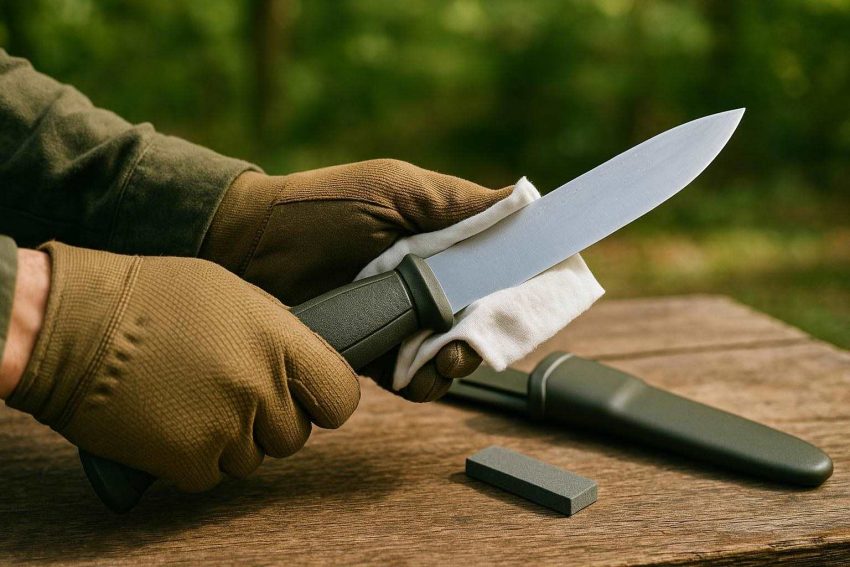
A weekend can expose a gear mistake quickly: the knife chosen for camp chores may be awkward, for food preparation too bulky to carry or poorly suited to cutting. The answer is not automatically a blade or an expensive handle. Choose a knife by the jobs it must perform then consider control, carry, weather resistance, maintenance and lawful use. This produces a tool you can handle safely and care for than gear chosen for appearance.
Start with the jobs, not the blade length
List the tasks you genuinely expect to perform. A knife for opening packaging trimming cord preparing food and cutting material has requirements from a hunting knife used for field dressing game. Combining roles may be practical. It creates compromises in cleaning, edge shape and carry comfort.
For food and general camp work a fine edge and controlled point are useful. A pronounced belly can help with slicing while a simple easy‑to‑clean profile is less troublesome around grease and food residue. For game processing, control and clean access matter more than a point. The knife should allow cuts without forcing your hand into a grip.
Wood processing is a concern. Cutting shavings or notches is not the same as chopping branches. A compact controllable blade may handle carving. Using a knife instead of an axe or saw increases the risk of slipping and damaging the edge. Treat blade tasks as limits, not possibilities.
Match the handle to control and conditions
A secure handle is more valuable than a material. Look for a shape that keeps your fingers away from the edge during work and remains manageable when wet. Deep grooves and aggressive contours may feel secure in one grip yet make other positions uncomfortable so consider how naturally the knife settles in your hand.
Gloves change the fit. A handle that feels indoors may become cramped with gloves. Leave room for a grip without squeezing hard; excessive force causes fatigue and reduces control during fine work.
Fixed blades avoid the moving parts found in folding designs. Can be straightforward to clean. Folding knives are often easier to carry. May suit everyday tasks but pivots and joints can collect grit, sap and food residue. Neither format is automatically better. Choose the construction that matches the work and the cleaning you will realistically perform.
Choose an edge for the material
A plain edge is usually the starting point. It is easy to inspect, clean and sharpen. Provides contact with ordinary materials. A serrated edge can help with fibrous materials but its teeth require a suitable sharpening method. Without one the extra feature may become a maintenance burden.
Blade steel involves trade‑offs than a winner. Corrosion resistance helps in weather around salt and during food preparation. Edge retention reduces sharpening frequency. Steel that is harder to sharpen may discourage maintenance. Toughness matters when a knife may encounter twisting or accidental impact though deliberate prying and chopping remain practice.
A thick spine can add confidence and durability. May reduce slicing performance. A thin keen edge can cut neatly yet requires handling. Consider the grind, edge condition and intended use together of treating one specification as a verdict.
Carry it so it stays controlled
Safe carry begins before the knife is used. A sheath should retain a fixed blade securely protect the edge and allow it to be drawn without placing fingers in its path. Check that fasteners are sound and that the sheath does not shift while walking. For a folder confirm that the blade stays closed during carry and that nearby gear cannot trigger the opening mechanism casually.
Keep the knife where you can control it not loose in a pack. Pass it handle‑first when another person needs it and close or sheath it before moving between tasks. Never leave a blade under clothing inside a bag or on a camp surface.
Local rules may govern blade length, locking mechanisms, concealed carry, transport and use in places. Requirements differ by jurisdiction. May change. Before carrying a knife check guidance from the relevant official authority, especially for parks, public land, vehicles and hunting. Lawful ownership is not a standard; permission in one setting does not establish permission in another.
Build maintenance into the
Maintenance is easiest when it follows use. Rinse dirt with water when appropriate dry the blade and inspect the edge under good light. Food residue tree sap and moisture deserve attention. Do not store a knife in its sheath because trapped moisture can encourage corrosion and damage some sheath materials.
Use care methods suited to the knife. Some handles tolerate water well; others need cleaning. Folding knives require attention around the pivot. Flooding a mechanism with oil can attract grit. Apply an amount of appropriate lubricant where the maker's guidance allows it.
Sharpen before the edge becomes frustratingly dull. A consistent angle and light controlled strokes are safer than grinding. If the edge has chips, bends or damage you cannot correct confidently stop using the knife for demanding work and seek sharpening or repair. Do not alter a blade to defeat a safety feature or create a point.
A practical selection check
Before buying or packing ask:
– What are the three likely blade tasks?
– Will food, moisture, grit or salt be part of the setting?
– Do I need fixed‑blade simplicity or folding‑knife portability?
– Can I hold and control it with the gloves I will use?
– Do the edge and steel suit my sharpening habits?
– Is the sheath or carry method lawful where I plan to go?
– Will I clean and dry it promptly after use?
The best choice answers those questions without pretending to do every job. A modest, well‑matched tool encourages handling and regular care. That is more useful, in the field. The world.